

Violin
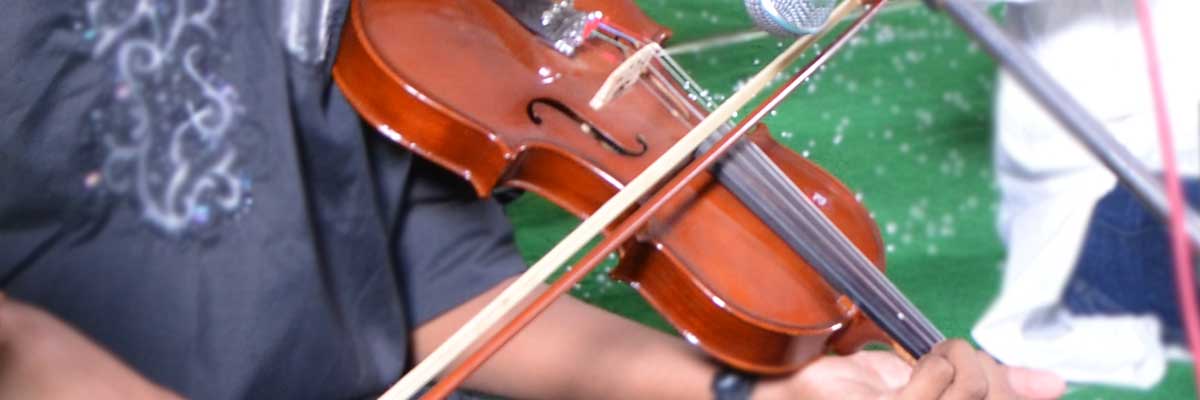
Violin is a bowed stringed musical instrument, the highest member of the violin family, consisting of a fingerboard, a hollow wooden body with waisted sides, and a sounding board connected to the back by means of a soundpost that also supports the bridge. It has two f-shaped sound holes cut in the belly. The instrument, noted for its fine and flexible tone, is the most important of the stringed instruments. It is held under the chin when played. Range: roughly three and a half octaves upwards from G below middle C
Playing the violin burns approximately 170 calories per hour. Forget about your workout and start practicing harder!
Violins are typically comprised of spruce or maple wood. Violins come in many different sizes. Typically, students will start learning violin at a young age with a 1/32 or 1/16 size violin. As the student ages they will graduate up to a full sized violin.
Violins are very complex. Over 70 different pieces of wood are put together to form the modern violin.
Violin bows typically contain 150 to 200 hairs. They can be made up of a variety of materials including nylon and horse hair.Violin strings were first made of sheep gut (commonly known as catgut), which was stretched, dried, and twisted. Other materials violin strings have been made out of include: solid steel, stranded steel, or various synthetic materials, wound with various metals, and sometimes plated with silver.