

Keyboard
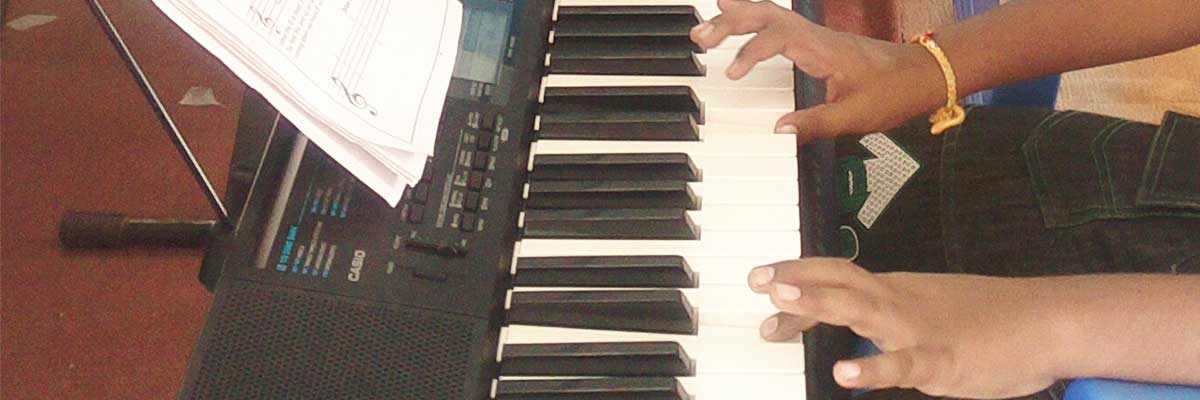
Keyboard instrument, any musical instrument on which different notes can be sounded by pressing a series of keys, push buttons, or parallel levers. In nearly all cases in Western music the keys correspond to consecutive notes in the chromatic scale, and they run from the bass at the left to the treble at the right.
The clavichord is rectangular in shape, and its strings run from left to right across the keys, which are placed along one of the longer sides of the rectangle. The soundboard of the instrument is at the right-hand end of the case, and the vibrations of the strings are communicated to it by a bridge on which the strings rest. The soundboard amplifies the sound of the strings by permitting them to set a large mass of air into vibration rather than the very small mass of air that contacts the string itself.
The sound of the wing-shaped harpsichord and its smaller rectangular, triangular, or polygonal relatives, the spinet and virginal, is produced by plucking their strings. The plucking mechanism, called a jack, rests on the key and consists of a narrow slip of wood with two slots cut into its top. The larger slot holds a pivoted tongue from which protrudes the quill, plastic, or leather plectrum that does the actual plucking; the smaller slot holds a piece of cloth that rests on the string and silences it when the key is not depressed. When the harpsichordist pushes down on a key, the back end rises, lifting the jack and forcing the plectrum past the string, plucking it. When he releases the key, the jack falls, and when the plectrum touches the string on the way down, it forces the pivoted tongue backward so that the plectrum can pass the string again without plucking it. Once the plectrum has passed beneath the string, a light spring made of bristle or metal pushes the tongue forward again. Finally, when the key is completely at rest, the cloth damper touches the string, silencing it. A wooden bar, padded on its underside, is placed over the jacks. The purpose of this bar is to prevent the jacks from flying out of the instrument and to limit the depth to which the keys can be depressed.